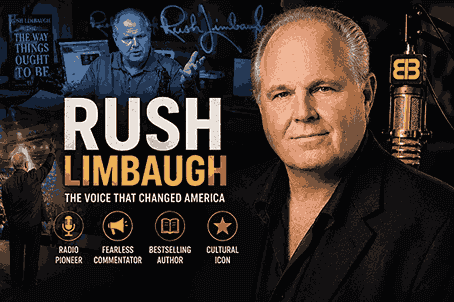
Rush Limbaugh: The Architect of Modern Talk Radio
Introduction
Many people struggle to understand the deep political divisions in American media today. The roots of this landscape are not a mystery. They trace directly back to one man who fundamentally changed the rules of broadcasting. Rush Limbaugh did not just host a radio show; he built a media empire and reshaped a political party. This guide provides a clear, factual examination of his methods, his rise to prominence, and the mark he left on the nation.
The Early Years and Path to Radio
Before he became a household name, Rush Limbaugh was a young man trying to find his place in the radio world. He was born in Cape Girardeau, Missouri, into a family of lawyers. His father, Rush Limbaugh Jr., was a prominent local attorney, and his grandfather, Rush Limbaugh Sr., served as a judge. This background gave him a strong, conservative foundation.
His path was not immediate. He attended Southeast Missouri State University but dropped out to pursue radio. He worked at several small stations under the on-air name “Jeff Christie,” gaining experience in Top 40 music and talk formats. These early jobs provided the practical training ground for his future career. He faced setbacks, including being fired, but he continued to refine his on-air persona. This period of trial and error was essential to developing the style that would later captivate millions.
The Rise of The Rush Limbaugh Show
The national launch of The Rush Limbaugh Show in 1988 was a pivotal moment in American media. It began on AM radio, a medium many had written off as outdated for entertainment. He syndicated his program from New York City, bringing a unique blend of political commentary, satire, and theatrical presentation. His timing was perfect. The repeal of the Fairness Doctrine in 1987 removed the requirement for broadcasters to present controversial issues in a balanced manner. This regulatory change allowed him to dominate the airwaves with his singular, opinionated perspective.
His style was unlike anything else on the air. He used humor, parody songs, and a confident, often confrontational tone to criticize Democrats, liberals, and the mainstream media. He connected with a massive audience that felt ignored by traditional news outlets. He became appointment listening, and his three-hour daily program turned into a powerful commercial success. Advertisers were eager to reach his loyal and engaged listeners.
The “Dittoheads” and the Power of Community
A key element of Limbaugh’s success was his ability to build a community. He called his dedicated listeners “Dittoheads,” a term that signified their agreement with his views. This was more than just an audience; it was a movement. Callers would begin their conversations by stating, “Ditto, Rush,” or “Mega dittos.” This created a sense of belonging and shared identity.
This community was a powerful force. Limbaugh could mobilize his listeners to contact politicians or respond to news events. This power was on full display during the 1994 midterm elections, when the Republican Party won control of the House of Representatives for the first time in 40 years. Many credited Limbaugh’s influence for this “Republican Revolution.” He was even made an honorary member of the freshman class of congressmen. He had proven that his voice could translate into real-world political action.
Political Influence and the Republican Party
Rush Limbaugh’s impact on the Republican Party was profound. He acted as a kingmaker and a gatekeeper. His endorsement could elevate a candidate, and his criticism could spell trouble. He was not an elected official, but he held more sway than many who held office. His philosophy of small government, lower taxes, and American exceptionalism became a blueprint for the party’s platform.
His commentary directly shaped the party’s messaging. He championed the “Contract with America,” a legislative agenda promoted by Newt Gingrich. His daily show served as a rallying point, providing a consistent narrative for conservative voters. He was a central figure in creating the highly partisan political environment that defines American politics today. He blurred the lines between entertainment, news, and political activism, creating a potent new formula.
Media Empire and Commercial Success
His talent for communication translated into immense commercial success. His radio show was the highest-rated talk radio program for decades. He signed a series of record-breaking contracts, at one point securing a deal worth $400 million over eight years. His financial success proved the viability of conservative talk radio as a business model.
Beyond radio, he expanded his reach through other media. He authored two best-selling books: The Way Things Ought to Be and See, I Told You So. He also had a short-lived television show in the 1990s. His newsletter and later his podcast, known as “The Limbaugh Letter” and “The Rush Limbaugh Show” podcast respectively, extended his influence into the digital age. He built a diversified media business that showcased his understanding of audience engagement.
Controversies and Public Backlash
Rush Limbaugh’s career was also marked by significant controversies. His provocative statements often drew sharp criticism from advocacy groups, political opponents, and advertisers. He was a polarizing figure who intentionally tested the boundaries of public discourse. He made derogatory remarks about women, people of color, and members of the LGBTQ+ community.
One of the most notable incidents occurred in 2012 when he made offensive comments about a law student who testified before Congress on contraception. The resulting public backlash led to a mass exodus of major advertisers from his program. This event demonstrated the power of social media-driven boycotts and highlighted the risks associated with his style. Despite these controversies, he retained a core audience and continued to be a powerful voice on the right.
Rush Limbaugh and the Rise of New Media
Limbaugh was a pioneer who anticipated the shift from traditional media gatekeepers to personality-driven commentary. He laid the groundwork for the modern media landscape, where opinion-based shows dominate cable news and the internet. He understood that presenting information through a strong ideological lens could be more engaging than objective reporting. This model has been replicated across the political spectrum.
His influence can be seen in the success of networks like Fox News and countless political podcasts and YouTube channels. He proved that a single individual with a strong point of view could build a massive audience and wield significant influence. He was a bridge between the old world of broadcast media and the new world of digital content creation. He taught future generations of commentators how to build a personal brand and monetize their opinions.
Health Struggles and Final Years
In his final years, Rush Limbaugh faced serious health challenges. He publicly announced in February 2020 that he had been diagnosed with advanced lung cancer. He used his platform to discuss his illness with his audience, sharing updates on his treatment and his hopes for recovery. His candor about his fight against cancer was a new chapter in his public life.
Despite his health struggles, he continued to host his show. The day after his diagnosis, he was awarded the Presidential Medal of Freedom by President Donald Trump during the State of the Union address. This moment underscored his immense political significance. He continued to broadcast as much as his health would allow, demonstrating his commitment to his work and his audience. He died on February 17, 2021. His wife, Kathryn, announced his passing on his radio show, marking the end of an era.
The Lasting Legacy of a Radio Icon
The legacy of Rush Limbaugh is complex and contested. To his supporters, he was a fearless truth-teller who gave a voice to millions of forgotten Americans. They see him as a conservative icon who single-handedly saved AM radio and reshaped American politics for the better. His contribution to the conservative movement is a central part of his story.
To his critics, he was a divisive figure who coarsened public discourse and spread misinformation. They point to his history of controversial statements and his role in creating a hyper-partisan media environment. The truth, as with most figures of his magnitude, lies somewhere in the complex interplay of these views. His legacy is not just in the history books but in the very structure of the media and political landscape we inhabit today.
Frequently Asked Questions
1. What was Rush Limbaugh’s net worth at the peak of his career?
At his peak, Rush Limbaugh’s net worth was estimated to be around $600 million. This figure was the result of his record-breaking radio contracts, book royalties, real estate investments, and his various media ventures. His financial success reflected his immense power as a media personality.
2. Where can I listen to old episodes of The Rush Limbaugh Show?
While the daily broadcast of new episodes ended with his passing, the show continues in a “Best of Rush” format on many affiliate stations. Premium podcast archives and select clips are also available through the official show’s website and digital platforms, offering access to his past commentary.
3. How did Rush Limbaugh get the Presidential Medal of Freedom?
Rush Limbaugh received the Presidential Medal of Freedom in 2020 from President Donald Trump. It was awarded in recognition of his decades-long influence on American politics and his contributions to the conservative movement. The award ceremony took place during the State of the Union address, a highly unusual and highly political moment.
4. What is the “dittohead” phenomenon associated with Rush Limbaugh?
“Dittoheads” was the name Rush Limbaugh gave his loyal listeners. It was a term of endearment that signified agreement with his views. This created a strong sense of community among his audience and became a defining characteristic of his show’s culture, symbolizing a shared political identity.
5. What was the Fairness Doctrine, and why was its repeal important for Limbaugh?
The Fairness Doctrine was an FCC policy requiring broadcasters to present contrasting views on controversial public issues. Its repeal in 1987 allowed Rush Limbaugh to host a show with a singular, opinionated perspective without being obligated to provide equal time to opposing viewpoints. This regulatory change was crucial to his format’s success.
6. Did Rush Limbaugh have any political positions of his own?
No, Rush Limbaugh never held an elected political office. His influence was exerted entirely from his position as a media personality. He was a commentator and opinion leader who shaped political debate from the outside, proving that power does not always require holding a formal title.
Conclusion
The story of Rush Limbaugh is more than a biography; it is the story of the transformation of American media. He was an architect of a new kind of public conversation, one that was loud, opinionated, and deeply personal. His methods changed the rules of the game for everyone who followed. To understand the modern political world, you must understand the man who reshaped it. Share your thoughts on his impact below.