Piracy Warning Luxury Cruise Passengers
1. Understanding Modern Threats on the High Seas
Taking a vacation on the ocean is a dream for millions of people around the world every year. It offers a unique blend of relaxation, incredible dining, and the chance to wake up in a new, beautiful destination every single morning. However, the world’s oceans are vast and sometimes unpredictable spaces. When you travel internationally by sea, you enter waters that are subject to complex laws and unique global challenges. While violent crime against huge commercial tourist vessels is incredibly rare, it is absolutely essential to stay informed about global maritime conditions.
In recent years, global news outlets have occasionally reported on security incidents occurring in major shipping lanes. These reports can easily create anxiety for travelers who are planning their dream vacations. It is completely normal to wonder about your safety when you are miles away from the nearest coastline. Modern ships are essentially massive, floating cities, and they face unique logistical and security challenges. Understanding the truth behind these maritime risks is the very first step toward having a relaxing and worry-free vacation. You must separate the frightening media headlines from the everyday reality of standard maritime travel.
By educating yourself on maritime safety, you take control of your travel experience. You will find that the ocean is heavily monitored and that your safety is always the top priority for any reputable travel company. The key is simply knowing what to look out for and how to prepare before you even pack your bags. We are going to explore everything you need to know about sea safety. This knowledge will help you relax and truly enjoy the endless buffets, sparkling pools, and incredible ocean sunsets.
2. Decoding the Piracy Warning Luxury Cruise Passengers Face
When travelers hear the word “pirate,” they often picture historical figures with eye patches and wooden legs. However, modern maritime crime looks completely different and is treated with extreme seriousness by global authorities. When governments issue a official piracy warning luxury cruise passengers need to pay close attention to the specific details provided. These warnings are usually highly localized and target specific bodies of water rather than entire oceans. The goal is never to incite panic, but rather to provide clear, actionable intelligence for all vessels operating in those specific regions.
It is important to understand exactly what a modern piracy warning luxury cruise passengers might read actually entails. Often, these alerts are primarily intended for slow-moving cargo ships or private, vulnerable yachts rather than massive tourist vessels. Cargo ships sit much lower in the water and have tiny crews, making them much easier targets for organized criminals. In contrast, a modern tourist vessel towers over the water like a skyscraper and carries hundreds of trained security personnel. Therefore, reading a piracy warning luxury cruise passengers are given requires a bit of practical context and critical thinking.
Even so, any official piracy warning luxury cruise passengers encounter should prompt a review of the ship’s planned itinerary. Travel companies monitor these alerts 24 hours a day, seven days a week, from dedicated command centers on land. If a threat level rises in a specific area, the captain will simply alter the course to avoid the region entirely. The ocean is incredibly vast, and there is almost always an alternative, safer route available to reach your destination. Your primary job is simply to stay aware, trust the highly trained crew, and enjoy your well-deserved holiday.
3. Global Hotspots: Routes with Higher Security Risks
While the vast majority of the ocean is perfectly safe, certain geographic choke points have historically presented higher risks for maritime crime. The Gulf of Aden, located near the coast of Somalia, is one of the most famous historical hotspots for global maritime incidents. Ships passing through this region to access the Suez Canal must travel through a relatively narrow corridor of water. Because of this, it is a location where you might frequently see a piracy warning luxury cruise passengers should be aware of.
Another notable region is the Gulf of Guinea off the western coast of Africa, which has seen fluctuating levels of security threats. The Strait of Malacca, a massive shipping lane between Indonesia and Malaysia, also requires heightened security protocols due to heavy maritime traffic. When sailing near these specific regions, any piracy warning luxury cruise passengers receive is taken incredibly seriously by the ship’s command team. You will likely notice that the ship speeds up significantly and moves much further away from the coastline during transit.
It is crucial to remember that tourist itineraries in these specific hotspots are generally very rare and highly specialized. Most mainstream vacations take place in incredibly safe regions like the Caribbean, the Mediterranean, or the breathtaking glaciers of Alaska. If you book a world-spanning voyage that must cross a known hotspot, your travel company will brief you thoroughly beforehand. They use dynamic risk assessment software to evaluate the route daily, ensuring that you are never placed in genuine danger.
4. Ship Safety Protocols: How Cruise Lines Keep You Safe
Your safety begins long before you ever step foot onto the gangway of your floating resort. Every major travel company employs a dedicated team of former military and intelligence officers who constantly monitor global security threats. These experts analyze satellite data, government intelligence, and local port reports to ensure your itinerary is completely secure. If they detect any credible threat, including a severe piracy warning luxury cruise passengers might face, the route is immediately changed.
Once you are on board, you are protected by a highly trained, dedicated security team working around the clock. These teams often include former law enforcement officers and military veterans who understand complex crowd control and threat mitigation. They manage secure access to the ship, ensuring that no unauthorized persons can board the vessel at any port of call. You must scan your personalized identification card every single time you leave or return to the vessel, creating a strict digital log.
In the highly unlikely event of an external threat, the ship operates under strict, international security protocols designed for immediate response. The crew conducts regular drills to practice locking down the vessel, securing exterior doors, and moving guests to safe interior locations. If there is an active piracy warning luxury cruise passengers will be kept informed by the captain through the public address system. Transparency is a core rule, ensuring everyone onboard understands the situation and knows exactly what to do to stay completely safe.
5. The High-Tech Defenses Aboard Modern Cruise Ships
Modern ocean liners are marvels of engineering, equipped with incredible technology designed specifically to deter and repel any external threats. One of the primary defenses is the massive physical size and speed of the ship itself, making unauthorized boarding nearly impossible. The lowest public decks are still situated many stories above the waterline, presenting a sheer, unscalable metal wall to small boats. Furthermore, these massive vessels can sustain high speeds that easily outpace the small, lightweight skiffs typically used by modern maritime criminals.
Beyond sheer size, ships are outfitted with advanced radar systems that can detect tiny, fast-moving objects miles away in pitch darkness. If an unidentified boat approaches too closely, the security team can deploy long-range acoustic devices (LRADs) to deter them. These devices emit a highly focused, painfully loud sound wave that makes it physically unbearable for attackers to get close to the ship. This non-lethal technology is highly effective and is a standard response to any severe piracy warning luxury cruise passengers might encounter.
Additionally, many ships can utilize powerful water cannons positioned around the lower decks to flood small boats and push them away. Night vision cameras and thermal imaging systems allow the bridge crew to see clearly through fog, rain, and the darkest nights. All of these incredible systems are integrated into a central command center that operates 24/7 to protect everyone on board. The combination of high-tech sensors and physical deterrents makes a tourist vessel an incredibly difficult and unappealing target for any criminal.
6. Preparing for Your Trip: A Safety First Approach
While the travel company handles the heavy lifting of security, there are several simple things you can do to prepare yourself. First, always register your travel plans with your home country’s state department or foreign office before you depart. Programs like the US STEP (Smart Traveler Enrollment Program) allow embassies to contact you quickly in case of an international emergency. This is a vital step, especially if your route includes areas known for a piracy warning luxury cruise passengers must navigate.
When packing, make sure to bring physical copies of all your important documents, including your passport, insurance, and medical information. Keep these copies in a separate, secure location from your actual documents, such as a hidden compartment in your suitcase. It is also wise to leave a detailed copy of your ship’s itinerary with a trusted friend or family member at home. This ensures that someone always knows roughly where you are in the world on any given day of your exciting vacation.
Familiarize yourself with the layout of your ship on the very first day you board, paying special attention to emergency exits. Locate your designated muster station, which is the specific area you must go to during any serious ship-wide emergency. Pay close attention during the mandatory safety briefing, even if you have sailed dozens of times in the past. Understanding the ship’s specific safety sounds and procedures is the best way to ensure you can act quickly and calmly if needed.
7. What to Do During a Real Maritime Security Drill
Within the first 24 hours of your voyage, international law requires that every single passenger participate in a mandatory safety drill. This exercise, commonly known as a muster drill, is incredibly important and should never be treated as an annoying inconvenience. During the drill, you will learn exactly how to put on your life jacket and where your specific emergency assembly point is located. The crew uses this time to verify that every single person on board understands the basic safety procedures for the vessel.
You will learn to recognize the general emergency alarm, which is universally recognized as seven short blasts followed by one long blast. If you ever hear this specific alarm, you must immediately return to your cabin, grab your life jacket, and proceed to your station. The drill also covers how the crew will communicate during a crisis, ensuring you know where to listen for official instructions. It is critical to stay silent during these announcements so that everyone around you can hear the captain’s important safety updates.
In regions where a piracy warning luxury cruise passengers face is active, the crew might conduct additional, specialized security drills. These “safe haven” drills teach you how to move away from exterior windows and balconies into the secure, central corridors of the ship. You may be asked to close your curtains, turn off your cabin lights, and sit quietly on the floor in the hallway. These drills ensure that the ship appears completely dark and quiet from the outside, drastically reducing its visibility to potential threats.
8. Responding to Threats: Your Personal Action Plan
If a genuine security incident occurs, the absolute most important rule is to remain calm and follow crew instructions immediately. The ship’s crew has trained extensively for exactly this scenario, and they know the safest way to handle the unfolding situation. Panic is your biggest enemy; taking a deep breath and listening carefully to the public address system will keep you grounded. If the captain announces a security threat related to a piracy warning luxury cruise passengers should step away from all windows instantly.
You will likely be instructed to move into the ship’s interior corridors, away from any exterior doors or vulnerable glass balconies. Do not attempt to go up to the open decks to see what is happening, as this puts you in extreme danger. Leave all your heavy luggage behind; only grab your essential medication and your life jacket if you are explicitly instructed to do so. Your physical safety is the only thing that matters, and your personal belongings can always be replaced later by your travel insurance.
Sit down low on the floor in the hallway, keep your voice to an absolute whisper, and wait patiently for further instructions. Do not use your cell phone to make calls or take photos, as screen light can be seen from incredible distances at night. The security team is actively managing the situation, and your cooperation helps them do their difficult job quickly and effectively. Once the threat has passed, the captain will announce an “all clear” message, letting you know it is safe to return to normal.
9. Navigating Travel Advisories and Government Warnings
Before booking any international trip, it is highly recommended to check your government’s official travel advisory website for current information. These websites provide detailed, up-to-date assessments of the security situation in virtually every country and major body of water worldwide. They will clearly outline if there is an active piracy warning luxury cruise passengers should consider before booking their specific itinerary. Government advisories use simple, color-coded tier systems to help you quickly understand the relative risk level of your desired destination.
It is important to read the full details of the advisory, not just the headline or the assigned risk level number. An advisory might be issued for a specific country due to localized crime, but the tourist ports themselves might be heavily secured. Similarly, a piracy warning luxury cruise passengers see might only apply to a tiny stretch of water that your ship traverses briefly. The travel company works closely with government agencies to ensure they fully understand the nuances of these important security advisories.
If a government advisory significantly upgrades its threat level for a region on your itinerary, the ship will simply not go there. Travel companies have zero financial incentive to put their billion-dollar vessels and thousands of guests into genuine, measurable danger. They will seamlessly pivot to a backup itinerary, swapping a high-risk port for a beautiful, safe alternative destination nearby. Your vacation will continue uninterrupted, and you will still get to enjoy incredible views, fantastic food, and world-class onboard entertainment.
10. The Vital Role of International Naval Coalitions
One of the biggest reasons major shipping lanes remain safe is the constant presence of international naval military forces. Numerous countries pool their resources to patrol the world’s most vulnerable waterways, creating a massive, highly visible deterrent to organized crime. The Combined Maritime Forces (CMF) is a prime example of a multinational naval partnership dedicated to promoting absolute security on the high seas. These heavily armed military ships conduct regular patrols, ensuring that vital global trade routes remain open and completely secure for everyone.
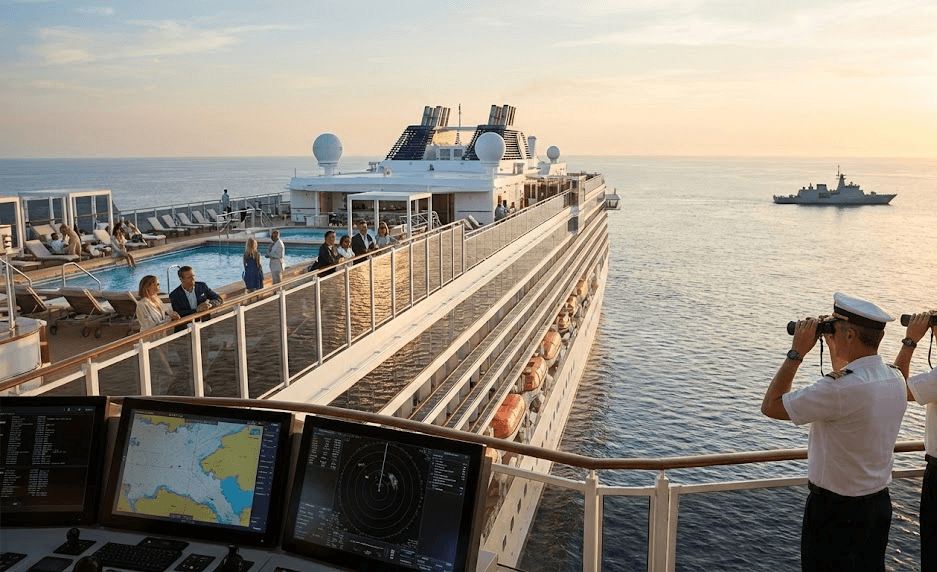
When a vessel must pass through a high-risk corridor, it often coordinates directly with these powerful international naval coalitions. The military provides a safe transit corridor, actively monitoring the commercial ship’s progress via advanced radar and constant radio communication. In areas with a frequent piracy warning luxury cruise passengers are traveling through, naval warships will sometimes provide direct, visual escorts. Seeing a massive military destroyer sailing alongside your ship provides an incredible sense of safety and profound peace of mind.
These coalitions also utilize advanced aerial surveillance, flying drones and maritime patrol aircraft over massive stretches of open ocean daily. This eye in the sky can spot suspicious, small boat activity long before it ever gets close to a commercial travel lane. If a threat is detected, the navy can intercept the suspicious vessel quickly, neutralizing the danger before it escalates. The global commitment to maritime security ensures that the oceans remain a safe playground for modern, adventurous travelers.
11. Travel Insurance and Maritime Security Events
Purchasing comprehensive travel insurance is a non-negotiable step when planning any significant international vacation, especially a sea voyage. Standard health insurance rarely covers medical emergencies that occur in international waters or in foreign countries, leaving you financially vulnerable. A robust travel policy protects your substantial financial investment against sudden cancellations, serious medical emergencies, and unexpected trip interruptions. If an itinerary changes dramatically due to a piracy warning luxury cruise passengers can often recover lost excursion costs through their insurance.
When selecting a policy, ensure you read the fine print regarding “acts of terrorism” or specific “security incidents.” Some basic, low-cost policies specifically exclude coverage for events related to organized maritime crime or sudden government travel advisories. You want a policy that offers “Cancel for Any Reason” (CFAR) coverage, giving you the ultimate flexibility to change your travel plans. If a newly issued piracy warning luxury cruise passengers receive makes you deeply uncomfortable, CFAR allows you to cancel without losing everything.
Additionally, ensure your policy includes high-limit medical evacuation coverage, which is absolutely critical when traveling far from land. If you experience a severe medical emergency at sea, the ship may need to air-lift you to the nearest mainland hospital. Medical evacuations from a moving ship can cost tens of thousands of dollars, a bill you do not want to pay out of pocket. Comprehensive insurance provides incredible peace of mind, allowing you to focus entirely on enjoying your much-anticipated, well-earned holiday.
12. Conclusion: Sail With Confidence and Preparedness
The prospect of traveling the world by sea is an incredibly exciting adventure that should be filled with joy, not anxiety. While it is vital to acknowledge that global risks exist, the reality is that the modern maritime industry is exceptionally safe. By understanding the context of a piracy warning luxury cruise passengers face, you realize these threats are heavily managed by experts. Your travel company, supported by international military forces, works tirelessly behind the scenes to ensure your absolute safety and comfort.
Preparedness is the ultimate antidote to travel anxiety; knowing what to do in an emergency empowers you to relax completely. Participate fully in safety drills, pack intelligently, and invest in a high-quality travel insurance policy before you leave home. You are embarking on a journey aboard a highly secure, technologically advanced vessel crewed by dedicated, well-trained professionals.
Are you ready to plan your next great ocean adventure? Start by reviewing the latest travel advisories for your dream destination, and share this guide with your travel companions today to ensure everyone sails safely!
13. Frequently Asked Questions (FAQs)
Q: How common are attacks on large tourist vessels? A: They are exceptionally rare. Due to the massive size, high speed, and advanced security protocols of modern ships, they are incredibly difficult targets for organized maritime crime.
Q: Will I be notified if my ship enters a dangerous area? A: Yes. If there is a credible piracy warning luxury cruise passengers will be informed by the captain, and the route will typically be changed to avoid the area completely.
Q: Do tourist ships carry armed guards? A: Most standard tourist ships do not carry heavily armed guards, but they do have highly trained security teams and utilize advanced non-lethal deterrents like water cannons and acoustic devices.
Q: What happens if a government issues a severe travel warning right before my trip? A: The travel company will constantly monitor government advisories. If a severe warning is issued, they will alter the itinerary to ensure passenger safety, swapping high-risk ports for safer alternatives.
Q: How do ships prevent unauthorized people from boarding at port? A: Ships use strict access control systems. Every passenger and crew member must scan a digital ID card to embark or disembark, and local port authorities maintain heavily secured, fenced-in perimeters.
Q: What is a safe haven drill? A: It is a specific emergency drill where passengers are taught to move to the interior, windowless corridors of the ship to remain safe and hidden during an external security threat.
About the Author